

ENDURANCE 4-SQUARE (SIDESHAFTS)
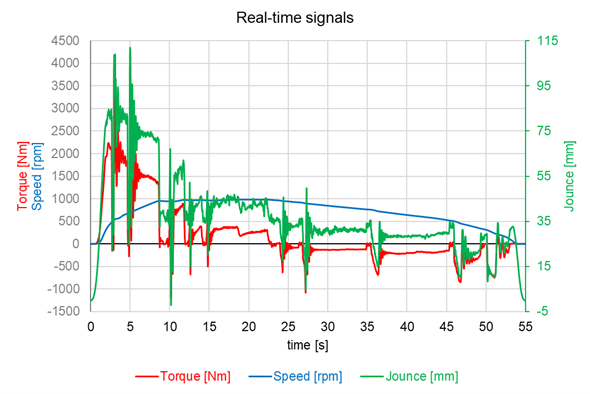


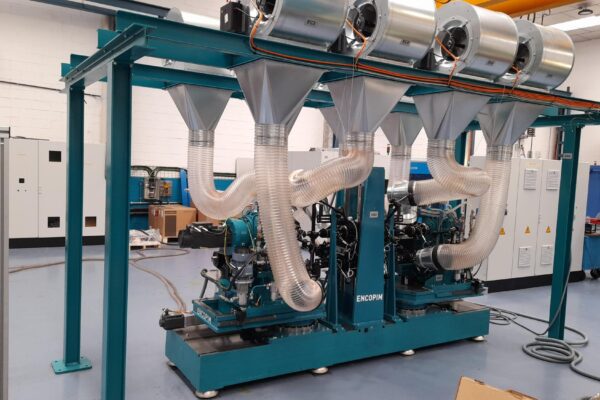
Four Square test rigs perform endurance testing on sideshafts by reproducing actual operating conditions in the vehicle such as, Torque, Speed, Jounce and an optional Steer Angle. These test rigs are capable of Real-Time testing based on Road Load Data or Multi-Block Programs.
The design is based on the well-known 4-square principle where 4 sideshafts (8 CVJ) are tested simultaneously. This method is both effective and efficient. The test rig consists of two opposed “turnaround” gearboxes with a Jounce Tower in between. This creates a speed and torque loop through the four specimens and two gearboxes. Torque is applied using Spinning Torque Actuators at the gear boxes.
Rotation is provided by two identical AC motors, each one driving at opposite corners of the rig and configured for load-sharing. This arrangement compensates for internal torque loses both in the shafts’ joints and in the test rig’s gearboxes resulting in minimal torque variation between all specimens around the loop. This is done by a special regulation feature in the control system of the test rig.
The Jounce Tower angulates all eight CV joints simultaneously. A linear offset is produced by a servo-electric or servo-hydraulic actuator, depending on specific requirements. This linear offset reproduces the jounce movements in the vehicle.
In addition to Torque, Speed and Jounce, Steering Angles can be produced with the use of recirculating ball screw electro-mechanical cylinders driven with servomotors which articulate the gearboxes at each end.
The temperature of all joints under test are monitored with pyrometers; air-cooling systems for the joints can be included.
Performance Parameters for standard configurations:
- Torques up to 4000 Nm
- Rotational speeds up to 3000 rpm
- Torsional angle rate up to 100 deg/s for servo-electric Spinning Torque Actuator and up to 600 deg/s for servo-hydraulic Spinning Torque Actuator
- Steering angle velocity up to 30 deg/s
- Jounce velocity up to 700 mm/s